Businesses are hearing two terms again and again right now: chatbot and AI agent. They often appear in the same sales pitch, the same software demo, and the same blog post. That is one reason so many people assume they mean the same thing. They do not.
This confusion causes real problems. A business may buy a chatbot and expect it to run a full workflow. Another may invest in an AI agent when all it really needed was a simple way to answer customer questions. In both cases, the tool is judged unfairly because it was chosen for the wrong job.
The good news is that the difference is not hard to understand once the jargon is removed. A chatbot is mainly built for conversation. It helps users get answers, find information, and move through simple requests. An AI agent goes further. It can work through steps, connect to tools, and take action to help complete a task.
That does not mean one is always better than the other. The right choice depends on what your business is trying to achieve. Some firms need a strong conversational tool that handles customer questions well. Others need a system that can support real workflow and reduce manual work behind the scenes.
This guide explains the difference in plain business English. It covers what a chatbot is, what an AI agent is, where each one fits, the pros and cons of both, and how to choose the right option for your business.
What is a chatbot?
A chatbot is a tool designed to communicate with users through text or voice. A person asks a question, and the chatbot replies. In most cases, its job is to make communication faster, easier, and more consistent.
For many businesses, a chatbot acts like a digital first point of contact. It can greet visitors on a website, answer common questions, guide people to the right page, collect contact details, or help them book an appointment. In customer support, it can reduce pressure on staff by handling routine enquiries before a human needs to step in.
Older chatbots were rule based. They followed a set script and worked only within narrow limits. If a customer asked about delivery times, returns, or opening hours, the chatbot could help. If the question fell outside the script, the conversation often broke down. That is why many people still think of chatbots as stiff, awkward, and frustrating.
Modern chatbots are better. Many use artificial intelligence and natural language processing to understand user questions in a more flexible way. They can respond in a tone that feels more human, and they can cope with a wider range of phrasing. Even so, their main role is still the same. They are built to manage conversation rather than to carry out complex work.
In simple terms, a chatbot is there to answer, guide, and support.
What is an AI agent?
An AI agent is built for more than conversation. It is designed to work toward an outcome.That is the key difference.
Instead of only replying to a user, an AI agent can look at a task, work through the steps needed, connect with other systems, and take action. It may still talk to the user, but conversation is only part of its role. The bigger aim is to help complete work.
For example, a chatbot might explain how to change a booking. An AI agent could check the booking, update the system, send a confirmation email, log the action in the CRM, and report back that the task is complete. That is a very different level of usefulness.
This is why AI agents are often linked with automation. They are not just there to provide information. They are there to help move work forward. In many cases, they connect with tools such as CRMs, calendars, email systems, project tools, support platforms, or internal databases. That gives them the ability to act across a workflow, not just within a conversation.
In simple terms, a chatbot gives answers. An AI agent helps get things done.

Chatbot vs AI agent in plain English
The easiest way to see the difference is to think about what happens after the user asks a question.
- A chatbot usually responds with information, guidance, or the next step. It is focused on the exchange between the user and the system.
- An AI agent can respond, but it can also take that request and do something with it. It can move from talk to action.
That is why the terms should not be treated as the same. A chatbot is mainly a conversational tool. An AI agent is more like a task driven assistant that can use connected tools and logic to help complete work.
This does not mean every business should rush out and buy an AI agent. In many cases, that would be the wrong move. A simple, well built chatbot may be exactly what the business needs. The point is not to choose the most advanced sounding option. The point is to choose the option that fits the problem.
Key differences between a chatbot and an AI agent
Here is a simple side by side view of the main differences.
| Feature | Chatbot | AI Agent |
|---|---|---|
| Main role | Conversation | Conversation and action |
| Focus | Answering questions | Completing tasks |
| Best for | Simple and repeated requests | Multi step work and workflow |
| User input | Usually reacts to a direct question | Can respond to a goal or trigger |
| Actions | Limited actions | Can carry out connected actions |
| Systems used | Often one interface or knowledge base | Often linked to CRM, email, calendar, database and more |
| Risk level | Lower | Higher if not controlled |
| Setup | Usually faster and simpler | Usually more complex |
| Cost | Often lower | Often higher |
| Best fit | Support, lead capture, FAQs | Operations, automation, complex business processes |
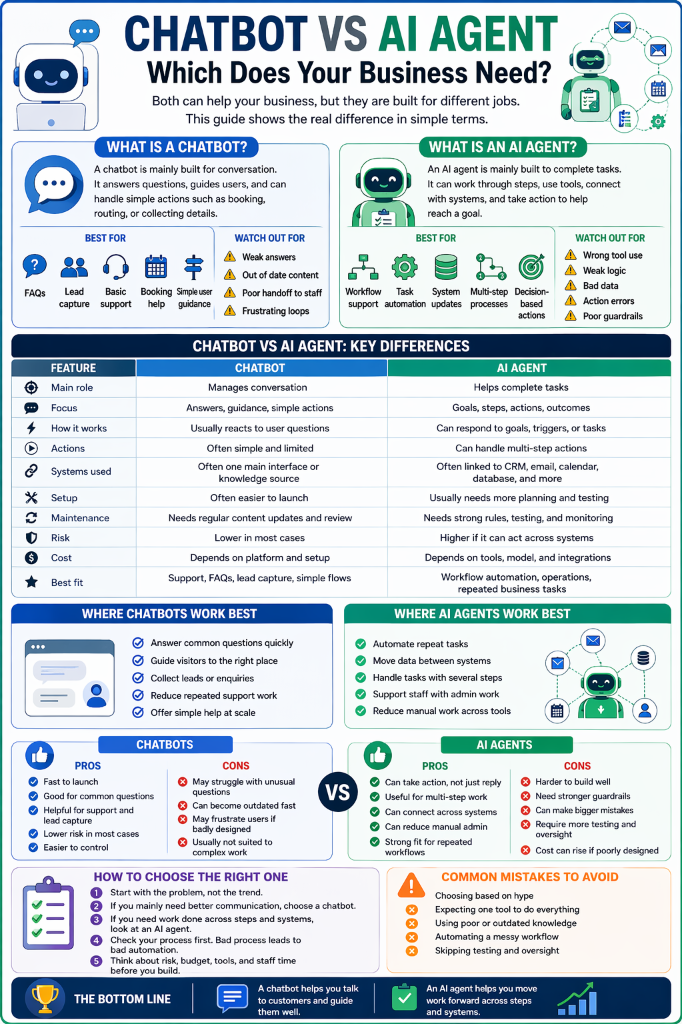
The main differences explained
The table gives a quick view, but it helps to look at the differences in a more practical way.
Purpose
A chatbot is mainly there to help a user get information. It responds to a question or request and tries to guide the person in the right direction. It is usually built to improve customer interaction.
An AI agent is built to help achieve a result. That result may involve several steps, more than one system, and some level of decision making within set rules.
Action
A chatbot may answer a question such as, "How do I book an appointment?" It might share a link, explain the process, or show available options.
An AI agent could go further and book the appointment, update the calendar, notify the team, and send the user a confirmation email. That shift from answer to action is a major part of the difference.
Complexity
Chatbots are usually best for tasks that are simple, common, and repeatable. They work well where the path is clear and the risk is low.
AI agents are more useful where work has several stages, relies on connected tools, or needs actions taken across systems.
Control
A chatbot is often easier to manage because its role is narrower. It may still make mistakes, but the effect is often limited to giving a poor answer or confusing the user.
An AI agent needs stronger control because it can take action. If the logic is poor or the guardrails are weak, mistakes can affect records, messages, bookings, or other parts of the business.
Where a chatbot works best
A chatbot is often the better choice when the main problem is communication.
It works well on websites where visitors ask the same questions again and again. That might include pricing queries, opening times, booking help, service details, return policies, or basic support requests. In these cases, a chatbot can save staff time and give users a quicker response.
It also works well for lead capture. A chatbot can greet the visitor, ask a few simple questions, collect contact details, and pass the enquiry to the right person. This can be useful for coaches, agencies, clinics, trades, and many service businesses.
Another good use case is internal support. A chatbot can help staff find company policies, onboarding documents, basic process guides, or answers to common internal questions. That reduces interruptions and helps people get what they need faster.
The strength of a chatbot is that it handles repeated conversations well. If the main need is to answer and guide, it can be a smart and cost effective solution.
Where an AI agent works best
An AI agent is usually the better choice when the business wants more than conversation.
It works well where tasks involve several steps and where actions need to happen across more than one system. That might include sales follow up, support case handling, reporting, workflow updates, or admin tasks that take time every day.
For example, an AI agent could review a new lead, score it based on set rules, add it to the CRM, draft a follow up email, and notify the sales team. In support, it could check account details, update a ticket, send a response, and escalate the issue if something looks wrong.
Marketing teams may use AI agents to pull campaign data, compare results, create summaries, and prepare updates. Operations teams may use them to move data between tools, flag issues, and reduce manual admin.
The value of an AI agent becomes clearer when the task does not stop at the answer. If the business wants to reduce repeated manual work, an AI agent can offer more value than a chatbot.
Pros and cons of chatbots
Every tool has strengths and weaknesses. A chatbot is no different.
Pros of a chatbot
- A chatbot is often quicker to launch. Many platforms let businesses add one to a website without a major project.
- It is usually easier to manage because the scope is narrower. The role is often clear, and the level of risk is lower.
- A chatbot can improve response times. Customers do not have to wait for a person to answer every routine question.
- It can reduce repetitive work for staff. That gives teams more time to focus on cases that need human judgment.
- It can also improve lead capture by engaging visitors early and collecting useful details.
Cons of a chatbot
- A chatbot can become frustrating if it is poorly designed. Users lose patience quickly when they feel trapped in a loop.
- It may struggle with unusual questions or requests that fall outside its range.
- It is limited in what it can do. Even when it sounds smart, it may not solve the real problem if it cannot take action.
- Some businesses also expect too much from chatbots. They install one and then assume it can run complex workflows, which leads to disappointment.
Pros and cons of AI agents
AI agents offer more capability, but they also bring more responsibility.
Pros of an AI agent
- An AI agent can automate real work, not just conversation. That is its biggest strength.
- It can handle multi step tasks that would normally take staff time and attention.
- It can work across connected business systems, which makes it useful for operations, reporting, support, and admin.
- It can improve speed and consistency when the workflow is clear and the rules are well set.
- For businesses with repeated processes, it can reduce manual effort and improve efficiency.
Cons of an AI agent
- An AI agent is harder to build well. It usually needs deeper planning, stronger testing, and better integration work.
- It carries more risk because it can take action. A mistake is not just a poor answer. It may affect records, communications, or systems.
- It needs guardrails. Without limits, approvals, and good monitoring, it can create problems.
- It can also cost more to build and manage, so the business case needs to be real.
- Most importantly, it will not fix a messy process by magic. If the workflow is unclear, the AI agent may only automate confusion.
Chatbot vs AI agent for real business needs
This is where the choice becomes practical.
A small business that gets repeated website enquiries may only need a chatbot. If the goal is to answer common questions, capture leads, and improve response time, a chatbot can do the job well.
A growing ecommerce firm may need more than that. It may want a system that handles support requests, updates orders, checks account details, logs actions, and passes only the harder cases to staff. In that situation, an AI agent may make sense.
A service business may use a chatbot at the front end and an AI agent behind the scenes. The chatbot handles the conversation, while the AI agent manages actions such as updating records, scheduling tasks, or sending follow ups.
This is an important point. The choice is not always either or. In some setups, chatbots and AI agents work well together. The chatbot manages the interaction. The AI agent supports the process.
The key is to match the tool to the work.
How to choose the right option
The best way to choose is to start with the problem, not the label. Ask what you need the system to do.
- If you mainly need to answer customer questions, guide users, reduce simple support work, or collect leads, a chatbot is often the right choice.
- If you need to reduce manual admin, connect different tools, automate parts of a workflow, or complete repeatable business tasks, an AI agent may be worth exploring.
It also helps to ask how much risk the business can accept. A chatbot is easier to control because its role is more limited. An AI agent needs clearer rules because it can do more.
Another useful question is whether your process is ready. If the workflow is messy, unclear, or inconsistent, it makes little sense to automate it with an AI agent. In most cases, the process should be cleaned up first.
You should also think about budget, technical support, and maintenance. A chatbot is often the lighter and quicker option. An AI agent may deliver more value, but it also demands more care.
Signs your business should choose a chatbot
A chatbot may be the right fit if these points sound familiar:
You get the same questions every day
If staff are answering repeated questions about services, bookings, pricing, support, or simple next steps, a chatbot can save time and improve response speed.
Your main need is better communication
If the issue is slow replies, missed website enquiries, or poor user guidance, a chatbot can help without adding too much complexity.
You want a lower risk starting point
If you are new to this area and want to improve the customer experience first, a chatbot is often the safer place to start.
Signs your business should choose an AI agent
An AI agent may be the better fit if these points sound familiar:
Your team spends time on repeat admin work
If staff keep doing the same steps in the same systems, an AI agent may help reduce that load.
Your workflow crosses more than one tool
If the work moves between email, CRM, support tools, calendars, or databases, an AI agent can be more useful than a simple chatbot.
The task needs action, not just answers
If the real value comes from updating records, sending messages, creating tasks, or moving work forward, an AI agent is more likely to fit.
Common mistakes businesses make
Many businesses make the same mistakes when choosing between chatbots and AI agents.
- Chasing hype: The newest sounding option is not always the right one. A simpler tool may solve the problem better.
- Expecting one tool to do everything: No system works well when the brief is vague. The clearer the task, the better the result.
- Ignoring process: If the workflow is unclear, weak, or inconsistent, even a strong AI agent will struggle.
- Skipping oversight: This is especially risky with AI agents. If the system can take action, the business needs controls, testing, and clear limits.
- Forgetting the user: It is easy to get excited about the technology and forget the actual person using it. If the experience is confusing, slow, or unhelpful, the tool has failed no matter how clever it sounds.
Frequently Asked Questions (FAQ)
What is the difference between a chatbot and an AI agent?
A chatbot is mainly built to talk with users. It answers questions and guides people. An AI agent can also take action, connect with tools, and help complete tasks.
Is an AI chatbot the same as an AI agent?
No. An AI chatbot is still mainly focused on conversation, even if it uses advanced language tools. An AI agent is built to go beyond conversation and support action.
Are AI agents better than chatbots?
Not always. AI agents are better for more complex tasks and workflows. Chatbots are often better for simple communication, FAQs, and lead capture.
When should a business use a chatbot?
A business should use a chatbot when it needs to answer common questions, guide users, improve response time, or reduce basic support work.
When should a business use an AI agent?
A business should use an AI agent when it wants to automate steps in a workflow, connect systems, and reduce repeated manual work.
Can a chatbot and an AI agent work together?
Yes. A chatbot can manage the front end conversation while an AI agent handles the actions behind the scenes.
Is an AI agent harder to set up than a chatbot?
Usually, yes. An AI agent often needs more planning, more testing, and more integration with business systems.
Do small businesses need AI agents?
Some do, but many do not. A small business may get more value from a well built chatbot first, especially if the main need is better communication.
Conclusion
The difference between a chatbot and an AI agent is not as complicated as the market sometimes makes it sound. A chatbot is mainly there to talk. It answers questions, guides users, and supports simple requests. It is often the right fit when a business wants to improve communication and reduce repeated support work.
An AI agent goes further. It can connect with tools, work through steps, and take action to help complete tasks. It is better suited to workflows that involve more than conversation.
Neither option is automatically better. The right choice depends on what your business actually needs. If the goal is faster answers and smoother interaction, a chatbot may be enough. If the goal is to reduce manual work and support a process across systems, an AI agent may be the better fit.
The smartest move is not to chase the most advanced sounding tool. It is to choose the one that solves the real problem in front of you.
This guide is written for business owners, marketers, and teams trying to understand where chatbots and AI agents really fit. It is designed to explain the difference clearly, without hype, and help businesses choose tools based on real needs rather than buzzwords.