People keep talking about this as something that's going to happen. It's happening now. In the first six months of 2025, nearly 78,000 tech workers lost their jobs directly because of AI. That's 427 people a day.
And here's the part that catches most people off guard: it's not factory workers going first this time. It's office workers. People who spend their days moving information from one place to another — reading documents, filling spreadsheets, answering emails, processing forms. If that sounds like your job, you're closer to the front of the queue than you probably think.
The High-Risk Roles (and why)
Data Entry & Administrative Clerks
AI processes documents faster, cheaper, and more accurately than any human — over 1,000 documents per hour with an error rate under 0.1%. Goldman Sachs puts office and admin support at the top of the automation pile, with 46% of all tasks automatable. The WEF lists data entry clerks as one of the fastest-declining jobs through 2030.
Customer Service Representatives
AI can now handle refunds, complaints, account changes, and product questions without a human anywhere near it. Companies are saving $8 billion a year by switching to AI-powered support. 80% of customer service roles are projected to go. Surviving roles will handle only highly complex, emotionally charged situations.
Paralegals & Legal Researchers
Reading contracts, finding precedents, drafting standard clauses — this is bread and butter for a large language model. Goldman Sachs ranks legal work second only to admin for automation exposure, with 44% of tasks automatable. Paralegals face an estimated 80% displacement risk. Senior lawyers who advise are fine; junior doc-reviewers are not.
Medical Transcriptionists
Tools like Nuance's DAX Copilot are already running in thousands of hospitals and clinics. They're faster, don't get tired, and their accuracy now outperforms trained human transcriptionists. This isn't a future threat — people in this role are already being let go in one of the clearest examples of real-time replacement.
Bookkeepers & Accounting Clerks
Payroll, reconciliation, tax prep, expense processing — all rule-based, structured, and extremely easy for AI to do faster and cheaper. Goldman Sachs puts financial operations in the top five most exposed sectors, with 35% of tasks automatable. The advisory chartered accountant is safe; the spreadsheet processor is not.
Cashiers & Bank Tellers
This displacement has been coming for a decade, and AI is finishing the job. Self-checkout, mobile payments, and automated banking apps have already gutted the numbers. The WEF puts bank tellers and cashiers firmly in the fastest-declining roles through 2030.
Junior Software Developers
Satya Nadella said it plainly: 30% of Microsoft's code is now written by AI, and over 40% of recent engineering layoffs hit developers. The junior end of coding — boilerplate, unit tests, bug fixes, simple features — is going fast. Developers must transition to directing and reviewing AI outputs.
Routine Content Writers
Product descriptions, SEO filler, templated blog posts — already being produced at scale by AI. If your writing is interchangeable with anyone else's, it's interchangeable with a machine's too. Writers with a genuine voice and a real point of view are a different story, but those jobs are competitive.
The Number That Changes Everything
The WEF says 170 million new jobs will be created by 2030 against 92 million lost. Net positive on paper. Great.
But the person losing their admin job in Coventry is not automatically the person building AI infrastructure in a data centre. The numbers balance on a spreadsheet. They don't balance in people's lives. Don't let the optimistic headline distract you from the personal maths.
The Jobs That Are Safe
Not everything is going. The roles that survive share one thing: they require you to show up — physically, emotionally, or creatively — in a way a machine genuinely can't fake yet.
Skilled Trades
A robot can't unblock your drain, wire your house, or fix a broken HVAC unit on the fly. Physical work in complex, unpredictable, and non-standardized real-world environments is genuinely hard to automate.
Mental Health Professionals
While some may talk to chatbots, people do not trust them with their deepest secrets and emotional recovery. Therapy relies on human presence, empathy, genuine accountability, and long-term relationships.
Surgeons & Complex Healthcare
AI assists with diagnostics and medical imaging, but it doesn't hold the scalpel or navigate critical, real-time operating room decisions. High-stakes physical intervention remains solidly human-led.
Teachers & Educators
A classroom is not just a portal for content delivery. Excellent education requires understanding behavior, building personal relationships, providing pastoral care, and reading the emotional state of a room.
AI & Data Specialists
The fastest-growing job category globally. Someone has to design, build, train, deploy, audit, and monitor these AI systems. If you build the automation, your job security is unparalleled.
Creative Directors
AI excels at raw production but lacks taste, cultural nuance, strategic alignment, and the ability to negotiate with clients. Senior creative judgment and visual curation have a long, resilient runway.
The Companies Already Doing It
This isn't hypothetical. In 2024–2025, the most profitable companies in the world cut tens of thousands of jobs while posting record revenues. Many named AI directly as the reason. These aren't redundancy cycles. They're structural changes.
| Company | Jobs Cut | What Happened |
|---|---|---|
| Microsoft | 15,000+ | Two rounds of cuts in 2025. ~40% hit software engineers. 30% of the company's code is now AI-written. They're not replacing those developers. |
| Meta | 8,000 | 10% of the workforce in early 2025. Recruiting, HR and middle management absorbed the bulk. Zuckerberg's goal: a leaner company running on AI agents. |
| Amazon | 30,000 | ~10% of corporate headcount removed since October 2024. The company simultaneously doubled its AI and robotics investment. The two facts are connected. |
| Salesforce | 4,000 | Customer support roles specifically. CEO Marc Benioff was direct: 'I need less heads.' They now sell AI agents to replace the same functions they cut staff from. |
| Klarna | 700 | Replaced their entire customer service function with AI — then reversed course 578 days later and started rehiring. The AI handled volume but couldn't handle the edge cases. Clients noticed. |
| Duolingo | 100 contractors | Mostly lesson writers. The work is now done by AI. Duolingo called it an 'AI-first' transition. |
| IBM | Hundreds | HR and back-office roles replaced by AI agents over 18 months. CEO Arvind Krishna said he expected AI to replace around 7,800 roles in total. |
So What Do You Actually Do About It?
Be honest about what you actually do all day.
Write down your last five days of tasks. How many follow a repeatable, structured process? How many require a creative or emotional call that only you could make? That ratio is your actual automation risk level.
Learn to use the tools, don't fight them.
85% of employers are already investing in AI upskilling internally. The people who figure out how to use AI well will absorb the work of the people who don't. That is already happening in most knowledge-worker industries.
Get closer to the decisions, not the tasks.
AI is incredible at execution and processing. It is terrible at deciding what to do, why it matters, and standing by the consequences. Opinions, taste, human relationships, and ultimate accountability are where value lies.
Make sure people can find you.
39% of current core skill sets will be outdated by 2030. The workers who land on their feet are the ones who make themselves easy to find and trust — an active network, a current CV, a visible reputation, and genuine expertise.
The Bottom Line
Your job probably won't disappear overnight. What's more likely is that the team around you quietly shrinks, the entry-level roles stop getting refilled, and suddenly you're expected to do 30% more with tools you've never been trained on.
The people who saw that coming and got ahead of it will be fine. The ones who assumed it wouldn't reach them are the ones reading job listings right now.
Visualizing the Shift: AI Job Exposure vs. Resilience
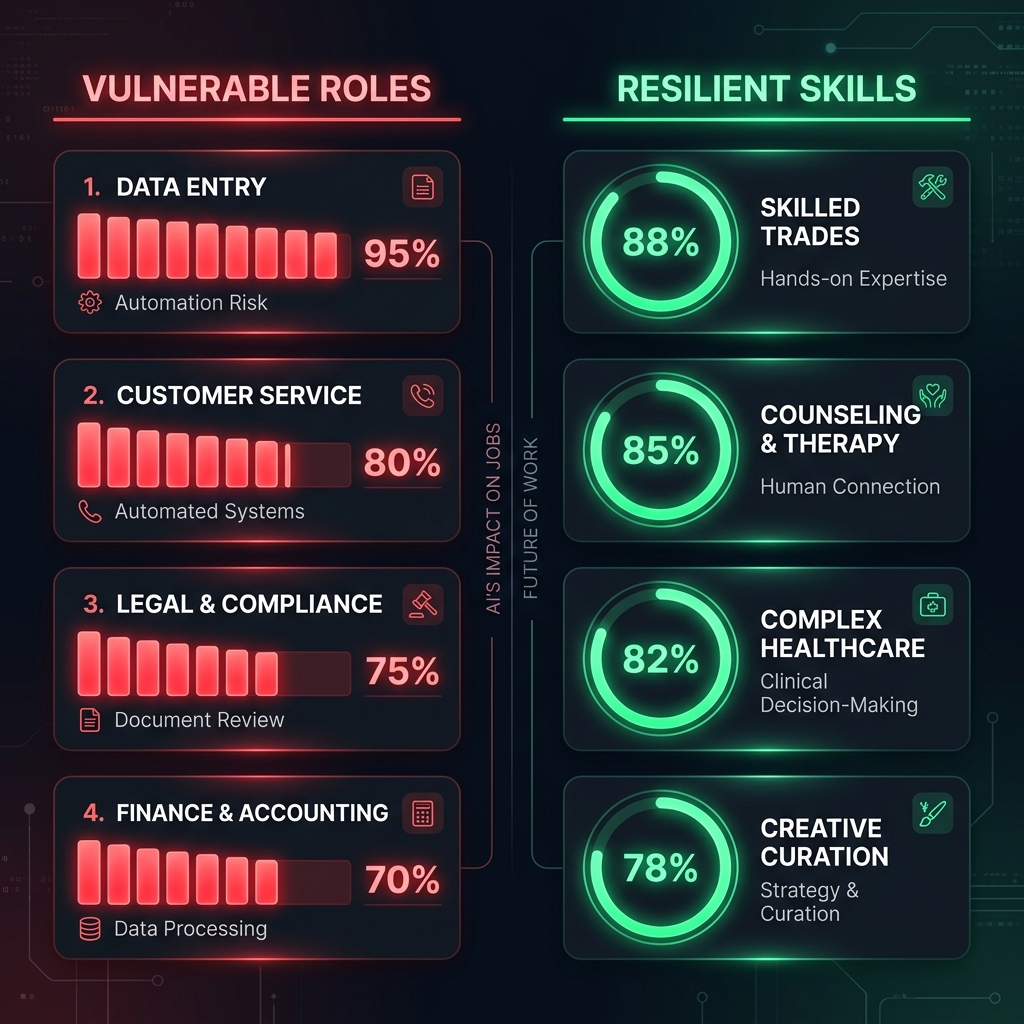
A visual summary mapping the automation risk levels of prominent career fields against key uniquely human cognitive and mechanical skills.